

Short answer: In the Karpenter vs Cluster Autoscaler debate, Karpenter is the better choice for most production workloads on AWS and Azure. Cluster Autoscaler is better where you need simple, predictable, scheduled scaling.
If you are comparing Karpenter vs Cluster Autoscaler for your Kubernetes cluster, this article will explain the difference in simple words.
What is Cluster Autoscaler?
Cluster Autoscaler (CA) is an older, standard Kubernetes tool for adding and removing nodes. It adds nodes when pods cannot be scheduled and removes nodes that are not needed.
In simple terms, you create a node group first, and each group usually has one machine type. When pods cannot fit, CA adds more machines of that same type.
What is Karpenter?
Karpenter is an open-source node autoscaler. AWS created it to improve Kubernetes cluster management. It creates the right machines based on the pods waiting to run, instead of using fixed node groups.
That is the core of Karpenter vs Cluster Autoscaler: one starts from your pods, the other starts from node groups.
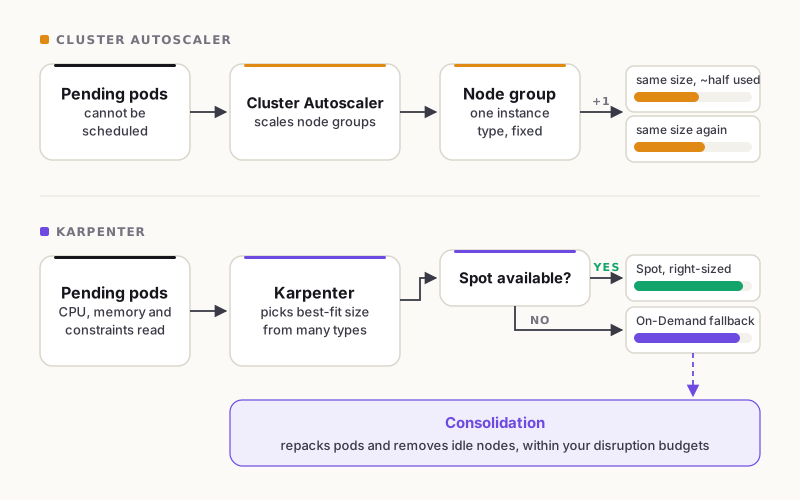
Cluster Autoscaler grows node groups. Karpenter starts from the pods.
Karpenter vs Cluster Autoscaler: Key Differences
| Feature | Karpenter | Cluster Autoscaler |
|---|---|---|
| How it works | Looks at pods, then picks the best machine | Scales fixed node groups |
| Instance sizes | Many sizes, chosen per workload | Usually one size per group |
| Spot instances | Built-in fallback from spot to on-demand | Needs manual setup |
| Cost saving | Consolidation removes wasted nodes | Less flexible |
| Disruption control | Disruption budgets | Limited |
| Scheduled scaling | Harder | Easier |
| Cloud support | AWS and Azure | AWS, Azure, GCP and more |
Why Karpenter Is Better
After working with both tools, my view is clear: Karpenter is better than Cluster Autoscaler today for most production use cases.
Here is why.
1. The right instance size for the workload
Karpenter chooses the right instance size based on your workload, so you only pay for what you need. Fixed node groups may leave you paying for large nodes that are only partially used.
2. Automatic fallback from spot to on-demand
Spot instances are cheap but not always available. If Spot instances are unavailable, Karpenter switches to On-Demand instances, keeping your pods running. You save money whenever Spot instances are available. With Cluster Autoscaler, you must manually configure Spot instances in your autoscaling groups.
3. Consolidation
Karpenter can move pods around and remove nodes that are not needed. This cuts waste automatically.
4. Disruption budgets
You control how many nodes can be disturbed at once and when this happens. This keeps your apps safe while Karpenter saves your money.
5. Works on both AWS and Azure
Karpenter is a tool that started on AWS with EKS. Microsoft has a similar tool for Azure called Node Auto Provisioning (NAP) for AKS, which is based on the Karpenter project but adapted for Azure. The same concepts are used in both cloud platforms.
The One Challenge: Scheduled Scaling
Karpenter is definitely not a perfect tool. In my experience, it is hard to do scheduled scale-up and scale-down of Karpenter nodepools compared to Cluster Autoscaler.
With Cluster Autoscaler, you can schedule the size of a node group, like adding more nodes at 9 AM and reducing them at 9 PM. Karpenter creates nodes only when pods need them, so it cannot easily follow a fixed node schedule.
Teams work around this by scheduling pods instead. Karpenter then adds or removes nodes as needed. This works but requires extra setup.
When to Use Each
Deciding between Karpenter and Cluster Autoscaler depends on your setup.
Choose Karpenter if:
- You run production workloads on EKS or AKS
- You want lower cloud bills
- You use spot instances
- Your workloads change often
Choose Cluster Autoscaler if:
- You run on GKE, where Cluster Autoscaler is the usual choice
- You run across many clouds and want one consistent tool
- You need simple, strict, scheduled scaling
- Your team already knows it well
Conclusion
After comparing Karpenter and Cluster Autoscaler on cost and control, Karpenter wins for most teams. It picks better instance sizes, handles spot-to-on-demand fallback, saves cost with consolidation, and gives you control through disruption budgets. Its one weak area is scheduled node scaling, which you can work around. For most production use cases today, we recommend using Karpenter instead of Cluster Autoscaler.
FAQs
Does Karpenter work on Azure?
Yes, AKS’s Node Auto Provisioning is built on Karpenter.
Does Karpenter support spot instances?
Yes, and it can fall back to on-demand when a spot is not available.
Can Karpenter do scheduled scaling?
You can’t use nodepools directly. Instead, you should schedule your pods and allow Karpenter to manage the nodes.
Is Karpenter better than Cluster Autoscaler?
Yes, for most production use cases on AWS and Azure.
Need help deciding between Karpenter vs Cluster Autoscaler?
Cloud Solitaire helps teams move from Cluster Autoscaler to Karpenter and cut Kubernetes costs. Talk to our team today!