

Every startup eventually has to pick a cloud, and the first question that arises is AWS vs GCP. The right answer depends more on your team, product, and stage rather than comparing features.
In short, choose Amazon Web Services (AWS) for a wide range of services and the trust of large enterprise customers. Choose Google Cloud Platform (GCP) if your team focuses on development, works with data or AI, and wants to launch products faster. Both are good for startups. The real question is which one your team can be productive on.
AWS vs GCP Comparison Table
| Factor | AWS | GCP |
|---|---|---|
| Market position | Largest share; the default for most startups and enterprises | Smaller share, strong in data and AI |
| Developer experience | Powerful but broad and complex | Cleaner, simpler, and more developer-friendly |
| AI and data | Bedrock, SageMaker, wide model choice | Vertex AI, Gemini, BigQuery, TPUs |
| Talent availability | Largest hiring pool | Specialists are harder to find |
| Track record | Longest, most proven at scale | Mature, especially in analytics and containers |
| Best fit | Broad B2B SaaS, complex or regulated workloads | AI-first, data-heavy, container-first teams |
Why Startups Choose AWS
In the AWS vs GCP debate, AWS market adoption is the strongest argument for AWS, which has been the default cloud for startups for over a decade. Here are some reasons:
- A proven track record. AWS has been running large-scale production workloads longer than any other provider. It offers over 200 services along with a wide range of tools, partners, and documentation.
- Easier hiring. Most DevOps engineers have AWS experience. That gives you a larger talent pool and faster hiring.
- Enterprise credibility. Procurement and security teams already know AWS, which can make B2B sales easier.
- Depth of services. Detailed Identity and Access Management (IAM) controls, managed databases like RDS and Aurora, and the flexibility to scale as your architecture grows.
The trade-off: All these options can be overwhelming for a small team with little cloud experience.
Why Startups Choose GCP
Google Cloud Platform focuses on improving the developer experience and using AI. Many developers find Google Cloud to be more user-friendly due to its simpler identity and access management (IAM), an intuitive console, and robust support for containers via Google Kubernetes Engine (GKE) and Cloud Run. Here are some features:
- Developer-friendly. Small teams can ship faster due to less configuration.
- World-class AI services. GCP is a natural home for AI-first and data-heavy products using Vertex AI, Gemini models, TPU access, and BigQuery.
- Strong startup credits. Google’s startup program offers credits up to $350K for eligible AI-first startups (tied to funding stage), while AWS Activate provides up to $100K in credits through participating accelerators and VCs.
The trade-off: A smaller pool of engineers who specialize in it, fewer niche third-party marketplace integrations compared to AWS, and some traditional enterprise buyers who are less familiar with its security tooling.
What We See With Our Clients
Across our clients, teams that picked a cloud purely for its credits often struggled later to hire engineers who knew the platform well. The teams that picked based on their engineering team’s existing skills shipped faster, avoided costly rework, and scaled more smoothly.
How Does Pricing Compare Between Clouds?
Neither cloud is cheaper across the board. GCP can offer lower baseline costs for uncommitted workloads because it automatically applies sustained-use discounts to certain Compute Engine machine types when run regularly. On the other hand, AWS provides deep savings to teams that commit through Savings Plans or Reserved Instances.
Both platforms offer credits that scale with funding stage and investor network (such as AWS Activate and Google for Startups Cloud Program). However, credits should discount your bill, not dictate your architecture. Calculate your actual workload costs using each cloud provider’s pricing calculator before making a final choice.
The India Context: Local Regions & Hiring
For startups operating out of India or targeting the Indian market, both providers offer strong local infrastructure and talent depth:
- Regions & Latency: AWS operates regions in Mumbai and Hyderabad, providing low-latency access and local data residency options. GCP offers infrastructure in Mumbai and Delhi NCR, giving developers strong redundancy options within the region.
- Local Talent Pool: While AWS engineers are widely available across major tech hubs like Bengaluru, NCR, and Hyderabad, GCP talent is growing rapidly—especially among data engineering and AI-focused dev teams.
- Accelerator Credits: Startup incubators and VC networks across India (such as Sequoia/Peak XV Surge, Blume Ventures, and T-Hub) routinely partner with both providers to offer local founders streamlined access to AWS Activate and GCP credit tiers.
A Simple Framework for Choosing Cloud Providers
- Check your team’s skills. Teams with AWS experience will build faster on AWS, and the same holds for GCP.
- Look at your product. AI-first or data-heavy products work well with GCP. Broad B2B SaaS, regulated industries, and complex integrations work well with AWS.
- Consider your customers. If you are targeting large enterprise companies, using AWS can help because they are already familiar with its compliance models.
- Plan your hiring. The size of the AWS talent pool matters if you need to grow an engineering team quickly.
- Compare credits and total cost. Credits can lower the bill, but they don’t choose the platform.
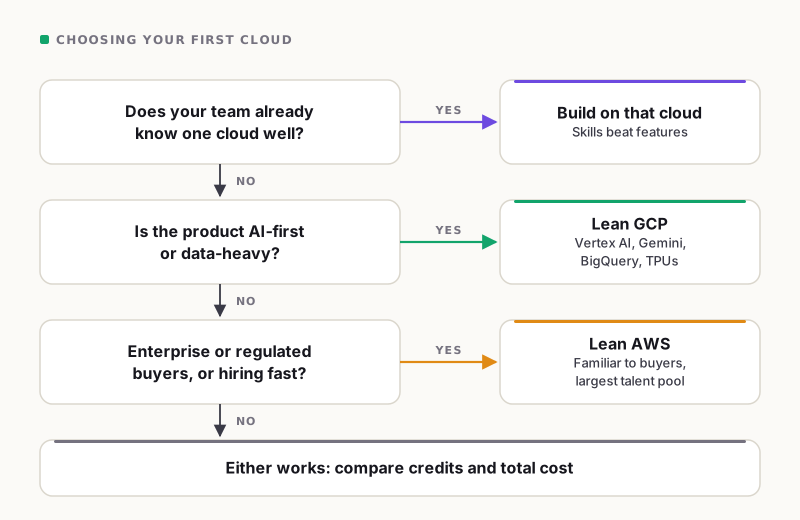
The framework above as a decision flow.
Can You Switch Clouds Later?
Yes, but it takes a lot of time and effort. Moving between cloud providers means reworking networking, IAM, managed services, and CI/CD pipelines. You can avoid vendor lock-in by using containers, Kubernetes, tools like Terraform, and databases that follow open standards. Early-stage startups rarely need a full multi-cloud setup.
Frequently Asked Questions
Is GCP cheaper than AWS?
Sometimes yes; GCP can be cheaper for uncommitted compute on supported machine types, while AWS often wins with committed usage plans. Your specific workload decides the winner.
Which is better for AI startups?
GCP offers Vertex AI, Gemini, and custom TPUs. AWS offers Bedrock, SageMaker, and Trainium/Inferentia chips. For AI-focused products, compare the specific foundation models, API latencies, and GPU availability you need.
Does the choice matter early on?
A well-architected setup on any major cloud is much better than a poorly configured one on the “ideal” cloud. Focus on team velocity first.
Conclusion
The AWS vs GCP decision is a pure bet on your team and roadmap. AWS is the lower-risk default, with the widest adoption, the longest track record, and the deepest talent pool. GCP is the sharper tool for developer-led, AI-first teams. There is no single best cloud for startups—whichever you choose, clean setup and architecture matter far more than the logo.
Not sure which cloud fits your startup?
Book a free 30-minute cloud architecture review with our team to get personalized guidance for your stack.