

Short answer: For infrastructure as code, pick Terraform if you use more than one cloud, or want to manage things beyond the cloud. Pick AWS CloudFormation if you only use AWS and want nothing extra to set up. Choose Pulumi if your team prefers to use real code in Python or TypeScript.
One of the first big decisions for a cloud team is to choose an infrastructure as code tool. After that, Terraform vs CloudFormation vs Pulumi is another important decision. Basically, all three do the same job: let you build servers, databases, and networks by writing code instead of clicking buttons in a console. But they work in very different ways, and the wrong pick can slow your team down for years.
What Is Infrastructure as Code?
Infrastructure as code (IaC) means you have to write your cloud setup in files. A tool reads those files and builds everything for you. This allows you to repeat the same setup again and again. You can track every change in Git. All the infrastructure as code tools in this article do this. The difference is how they do it.
Terraform: The Flexible Choice
Terraform is one of the most popular infrastructure as code tools today. It is made by HashiCorp and uses a simple, easy-to-read language called HCL. It works with AWS, Azure, Google Cloud, and thousands of other Terraform providers.
Here is the big reason why people prefer it: Terraform is not limited to cloud providers. You can also manage GitHub repositories, Cloudflare DNS, Datadog dashboards, and PagerDuty alerts with it. One tool, one workflow, one place to review changes.
Two more advantages are:
- The Terraform plan shows you exactly what will change before anything happens.
- It has a huge community and many ready-made modules, so you don’t have to start from zero.
What to watch out for: HashiCorp changed Terraform’s license in August 2023. IBM acquired HashiCorp in February 2025. For most teams, this makes little difference in daily use. But if you want a fully open-source option, consider OpenTofu, a community-developed alternative to Terraform.
AWS CloudFormation: AWS Only, Built-in
AWS CloudFormation is Amazon’s own infrastructure as code service. You write templates in YAML or JSON, and there is no extra charge for using it with standard AWS resources. AWS usually supports new features quickly. If an update fails, it can roll back automatically.
The disadvantages are:
- It works with AWS only. If you add another cloud or tool later, you need a second approach.
- Templates get long and wordy. A simple setup can take hundreds of lines.
- Finding out why a stack failed can be slow and frustrating.
I find CloudFormation difficult to use, and it only works with AWS. This can lead to vendor lock-in, making it harder to switch to another cloud provider later.
Pulumi: Real Code for Developers
Pulumi lets you write infrastructure as code in languages you already know. It supports TypeScript, Python, Go, .NET, Java, and YAML. It supports multi-cloud setups and can also use Terraform providers.
In a Pulumi vs Terraform choice, Pulumi wins when your team is full of developers who dislike learning a new language. Use Pulumi when your engineers want to manage infrastructure just like regular application code.
The disadvantages are:
- The community is smaller than Terraform’s.
- Full programming power can lead to code that is too clever and hard to read.
- Team members who don’t write code may find it harder to review.
Side-by-Side Comparison
| Terraform | CloudFormation | Pulumi | |
|---|---|---|---|
| Language | HCL | YAML / JSON | Python, TypeScript, Go, C#, Java |
| Clouds | Many | AWS only | Many |
| Manages tools beyond cloud (GitHub, Datadog) | Yes | Limited | Yes |
| State file | You manage it (remote backend) | AWS manages it | Pulumi Cloud or self-managed |
| Community size | Very large | Large (AWS users) | Smaller, growing |
| Best for | Multi-cloud, mixed tools | AWS-only teams | Developer-led teams |
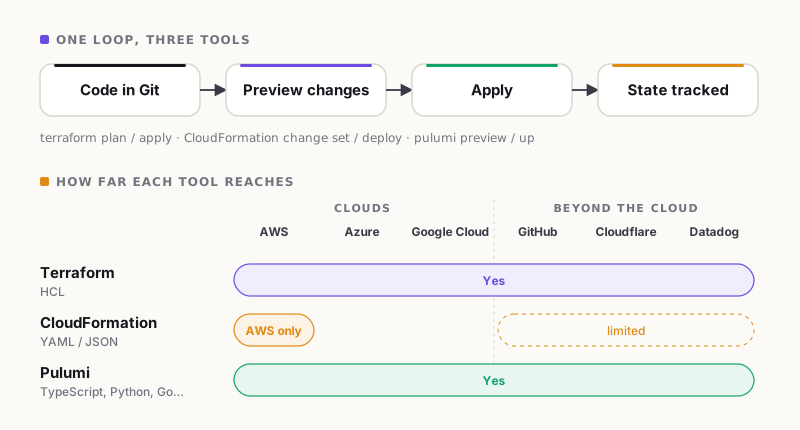
Same workflow, different reach.
When Each One Actually Makes Sense
Choose Terraform when:
- You currently use, or may soon use, multiple cloud services.
- You want to manage tools beyond the cloud, like GitHub, DNS, and monitoring.
- You want the biggest community and the most examples to learn from.
Choose CloudFormation when:
- You are 100% on AWS and plan to stay there.
- There is nothing to install, and AWS keeps track of your state for you.
- Your team already knows it well.
Choose Pulumi when:
- Your team is mostly software developers.
- You want to reuse code, write tests, and use familiar languages.
- You prefer to manage a smaller ecosystem for greater flexibility.
The best infrastructure as code tool is the one your team can use well. If you’re unsure, start with Terraform. It’s a reliable choice for growing teams.
What We See at Cloud Solitaire
For most teams, Terraform is usually the choice. Real projects expand beyond a single cloud. A team starts on AWS, then adds Cloudflare, GitHub, and monitoring tools. Terraform handles all of it in the same workflow, while CloudFormation stops at the AWS border. We see CloudFormation as a fit only for teams that are fully committed to AWS.
Frequently Asked Questions
Is Terraform better than CloudFormation?
Yes, for most teams, Terraform works across many clouds, while CloudFormation works only with AWS. If you are fully on AWS and want the simplest start, CloudFormation is still a fair choice.
What is the best infrastructure as code tool for beginners?
Terraform. Its HCL language is easy to read, and there are plenty of free tutorials and examples.
Can I use Terraform and CloudFormation together?
Yes. Terraform lets you deploy CloudFormation stacks from inside your Terraform code. This helps if Terraform is missing a new AWS feature.
Not Sure Which Tool Fits Your Team?
Choosing the wrong infrastructure as code tool can be costly to fix later. Book a free 30-minute cloud architecture review with Cloud Solitaire, and we will tell you which tool fits your cloud, your team, and your budget.